Without insurance, GLP-1 medications typically cost between low to mid hundreds of dollars a month through manufacturer self-pay programs or telehealth, or around nine hundred to over one thousand dollars a month at retail list price. The lowest legitimate options for uninsured patients are manufacturer self-pay programs (oral options from $149, injectable tiers at $299 to $499) and select telehealth pathways, though eligibility rules vary and some offers exclude Medicare or Medicaid beneficiaries.
TL;DR:
- Manufacturer self-pay programs offer the lowest verified prices, typically around $149 for oral doses and $299 to $449 for injectables, but prices may increase after initial usage.
- Retail pharmacy list prices range from $900 to over $1,350 monthly, making them significantly more expensive than direct manufacturer options for uninsured patients.
- Telehealth, compounded drugs, and discount cards can provide cheaper access but often involve risks, variable quality, or limited coverage, especially for government beneficiaries.
- Medicare’s upcoming GLP-1 Bridge program will reduce copays to $50 monthly for eligible beneficiaries, though eligibility criteria and coverage vary by state for Medicaid.
- Supervised care approaches, like Zealthy’s platform, offer fast, integrated services with provider oversight, which can help navigate dosing, eligibility, and cost considerations more safely.
Table of Contents
- Quick Price Ranges by Payment Route
- How Manufacturer Self-Pay Programs Actually Work
- Telehealth Subscriptions, Compounded Drugs, and Discount Cards
- Medicare, Medicaid, and Special Access Programs
- How to Actually Lower Your Monthly GLP-1 Bill
- What Uninsured Patients Get Wrong About “Cheap” GLP-1s
- A Clinician-Managed Path to GLP-1 Access
- Sources
- FAQ
Quick Price Ranges by Payment Route
Where you buy your prescription matters just as much as which drug you’re taking. The same medication can cost six times more depending on the route you choose.
- Retail list price ($900 to $1,350+ per month): This is the pharmacy’s undiscounted “sticker price,” what shows up if you walk in with a prescription and no coupon, savings card, or manufacturer program attached, according to the National Consumer Law Center.
- Manufacturer self-pay programs ($149 to $449 per month): Oral starter doses often price at $149, standard injectable tiers land around $349, and some vial-based options (like certain Zepbound doses) run $299 to $449 depending on dose and refill schedule, per GLPbase’s pricing data.
- Telehealth and compounded lanes ($149 to $349 per month): These platforms often bundle a provider visit into the price and can get a prescription moving within days.
- GoodRx and pharmacy discount cards: Intro pricing often starts around $199, then settles into an ongoing range of $299 to $349, according to GLP-1 News Today’s cost guide.
- Medicare Bridge and Medicaid: A flat $50 monthly copay for eligible Medicare beneficiaries at one extreme, and wildly inconsistent Medicaid coverage at the other, depending on your state.
Dose strength and drug form (oral tablet versus injectable pen) shift these numbers considerably, so the price you see advertised is rarely the price everyone pays.
How Manufacturer Self-Pay Programs Actually Work
Manufacturer self-pay programs let you buy the medication directly from the drugmaker, outside your insurance plan entirely. You still need a valid prescription, and you pay cash (or card) at checkout rather than filing a claim. These programs exist because manufacturers want to capture patients who’d otherwise walk away over price, and they’re often the most reliable FDA-approved, brand-name option for someone without coverage.
Here’s what to know before you commit:
- Introductory pricing is often temporary. That $149 or $199 rate might apply only to your first fill or first few months before shifting to a standard rate.
- Refill timing affects your price. Missing a refill window can bump you out of promotional pricing and into standard tiers.
- Government beneficiaries are frequently excluded. Many manufacturer self-pay programs explicitly bar Medicare and Medicaid enrollees from participating, even if they’re paying cash.
- Shipping and cancellation policies vary by manufacturer and aren’t always disclosed upfront.
Pro Tip: Before entering payment information, confirm the exact dose you’ll receive, how often refills ship, and whether the listed price is locked for a set number of months. A “starting at” price and your actual monthly bill are not always the same number.
Telehealth Subscriptions, Compounded Drugs, and Discount Cards
Beyond manufacturer programs, three other cash-pay routes dominate the market, and each comes with a different risk-to-savings ratio.
Telehealth subscriptions typically bundle a provider consultation into a flat membership fee, with medication priced separately or included depending on the platform. Turnaround to a first dose can be a matter of days rather than weeks.
Compounded 503A products are the cheapest advertised option in many cases, but they’re not FDA-approved versions of the branded drug, and quality can vary between compounding pharmacies. The FDA has issued specific guidance for telehealth companies promoting compounded drugs, and enforcement scrutiny on bulk compounding has increased.
- Ask whether the product is FDA-approved or compounded before paying anything.
- Check whether the pharmacy is licensed in your state.
- Confirm the active ingredient dose matches what your provider prescribed.
GoodRx and similar discount cards often mirror manufacturer promotional pricing rather than beating it. A GoodRx-type coupon commonly matches the $199 intro rate before settling into the same $299 to $349 ongoing range you’d see elsewhere. One detail trips up a lot of shoppers: manufacturer savings cards only reduce a copay when a commercial insurance plan is already covering the prescription. Without insurance, that card is worthless, and the self-pay program is the actual applicable path.
Medicare, Medicaid, and Special Access Programs
Government coverage for GLP-1s is a patchwork, and it changes the math substantially for eligible patients.
- Medicare GLP-1 Bridge demonstration: Running from July 1, 2026 through December 31, 2027, this program offers a flat $50 monthly copay for eligible beneficiaries with qualifying BMI and comorbidity criteria. That $50 does not count toward the Part D out-of-pocket maximum, which means it can add up over a full year even though each month looks cheap.
- State Medicaid programs: Coverage for obesity-related GLP-1 prescriptions varies enormously by state, with some covering it fully and others excluding weight-loss indications entirely. Check your state’s Medicaid formulary directly rather than assuming coverage.
- Program overlap: Manufacturer self-pay offers frequently exclude anyone enrolled in Medicare or Medicaid, so government coverage and self-pay discounts usually aren’t stackable.
If you’re on a government plan, verify your specific benefit before assuming either the Bridge copay or a manufacturer discount applies to you.
How to Actually Lower Your Monthly GLP-1 Bill
Cost control here isn’t about finding one secret discount. It’s about checking the right things in the right order before you swipe a card.
- Price the exact same dose across every lane first. A 2.4 mg weekly injection and a 1 mg dose from the same manufacturer can carry very different self-pay prices, and pricing is often comparable across platforms once you match dose for dose.
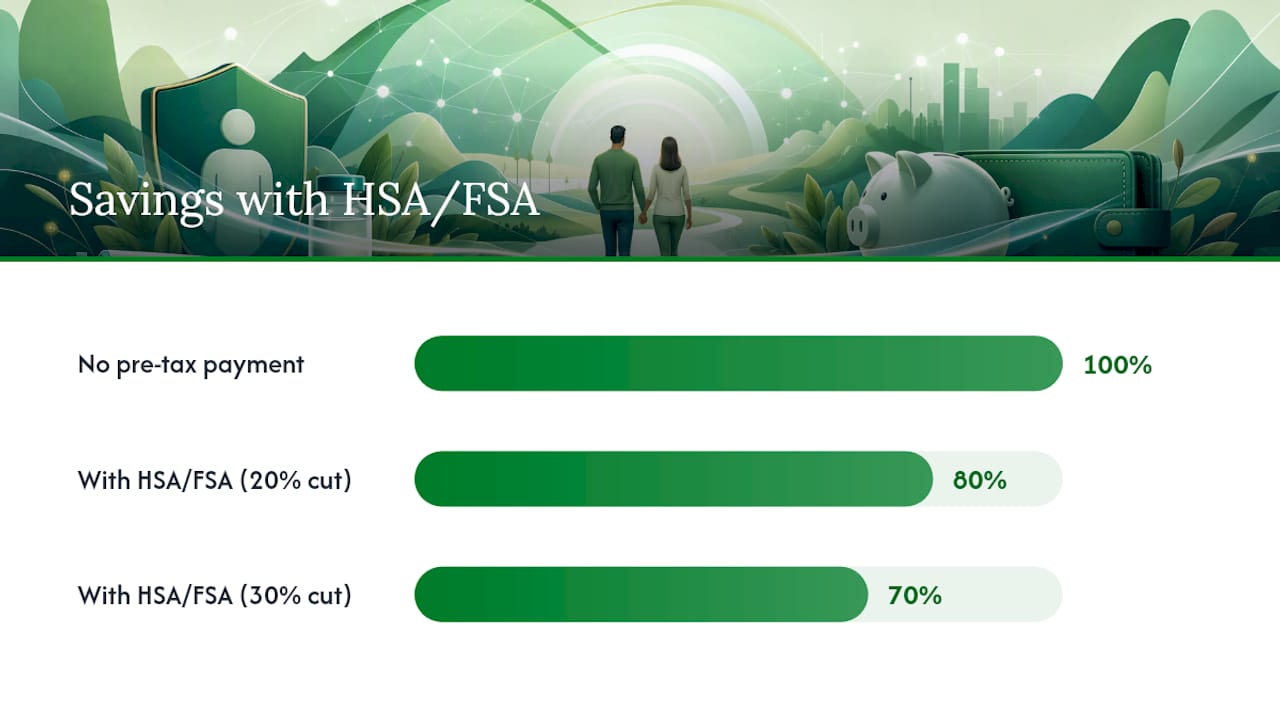
- Run the numbers through an HSA or FSA if you have one. Paying with pre-tax dollars can effectively cut your real cost by 20% to 30%, depending on your tax bracket.
- Search for sliding-scale clinics and patient assistance programs in your area, particularly through community health centers, which sometimes offer income-based pricing outside the standard manufacturer or telehealth channels.
- Confirm eligibility before you pay, not after. Ask directly whether a coupon requires commercial insurance, whether a self-pay program excludes government beneficiaries, and whether the “intro price” has an expiration date.
Pro Tip: Call the pharmacy or manufacturer support line and ask, “What will this cost me in month four?” not just month one. Introductory pricing tells you almost nothing about your annual spend.
Comparing GLP-1 access without insurance against the insurance-covered pathway is worth doing even if you’re currently uninsured, since your situation may change and prior authorization rules differ substantially between the two.
What Uninsured Patients Get Wrong About “Cheap” GLP-1s
The instinct to chase the lowest number on the page is understandable, and it’s also the mistake I see most often in how this market gets covered. Compounded products advertise the steepest discounts, but that pricing gap exists precisely because these products sidestep the FDA approval process that branded manufacturer versions go through. That’s not a reason to panic, but it is a reason to ask harder questions before you buy.
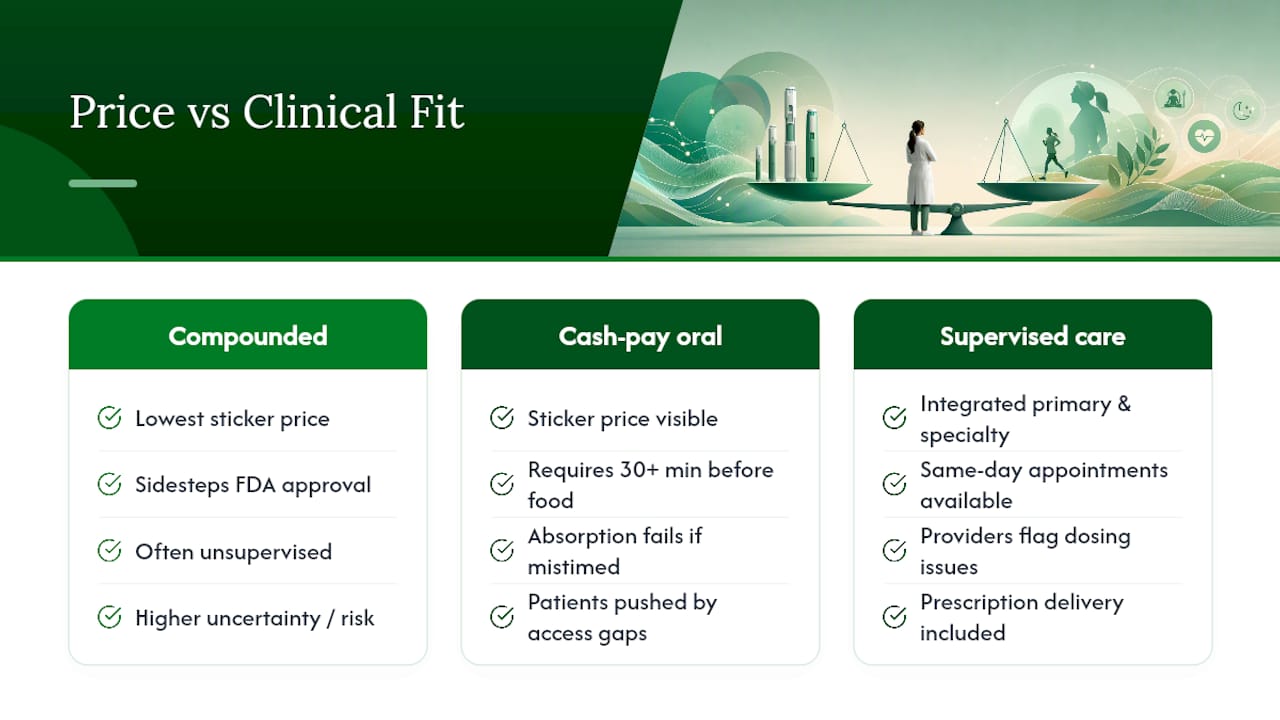
The more interesting story is how differently “self-pay” and “insurance” patients experience the same drug. A cash-pay patient on an oral GLP-1 has to time doses around meals with real precision, taking the medication at least 30 minutes before food or other medication, or the drug simply doesn’t absorb properly. Nobody warns you about that when you’re comparing sticker prices. Cost and clinical fit are tangled together in ways a price chart alone can’t capture, which is exactly why supervised care matters more for GLP-1s than it does for most cash-pay medications.
Zealthy’s approach reflects that reality: integrated primary care, specialty treatment, and prescription delivery under one roof, with same-day appointments that get a patient from question to prescription without the multi-week gaps that push people toward unsupervised options out of frustration. That structure, paired with providers who can flag dosing issues, adherence problems, or program eligibility questions in real time, is what turns a confusing cash-pay market into something a patient can actually navigate safely.
— Bryan
A Clinician-Managed Path to GLP-1 Access
This service offers an alternative to independently navigating compounded pharmacies and expiring coupon codes by providing licensed provider evaluations, prescription decisions based on health history, and home delivery through a unified platform that accepts HSA and FSA payments.
This route fits patients who want supervised care rather than a mystery vial from an unfamiliar compounding pharmacy, and who value same-day scheduling over waiting weeks for a callback. Zealthy’s providers can also walk you through how semaglutide compares to tirzepatide for your specific goals, since drug choice affects both cost and results. If you’re ready to see what a supervised, cash-pay-friendly plan looks like for your situation, visit the Zealthy weight loss page to start an evaluation.
This article is general information, not a substitute for advice from a qualified doctor. Consult a qualified healthcare professional about your own circumstances before acting on anything here.
Sources
- FDA — Telehealth companies and compounded drugs guidance
- Cms
- GLP-1 Medication Prices 2026: What People Pay - GLPbase
- GLP-1 Cost Guide 2026: Every Pricing Route, Honestly Compared | GLP-1 News Today
- PMC article on oral semaglutide administration
FAQ
Who Sells the Cheapest GLP-1 Without Insurance?
Manufacturer self-pay programs typically offer the lowest verified prices for FDA-approved brand-name GLP-1s, with oral starter doses around $149 a month, though prices change often, so confirm current rates directly with the manufacturer before buying.
How Are People Getting GLP-1 Without Insurance?
Most uninsured patients use one of three routes: manufacturer self-pay programs, telehealth platforms that bundle a consultation with medication, or discount cards like GoodRx that mirror manufacturer promotional pricing.
How Much Is GLP-1 at Costco?
Warehouse pharmacy pricing for GLP-1s generally tracks close to retail list price, often in the $900 to $1,350 range without a discount card or manufacturer program applied, since these aren’t typically manufacturer self-pay partners.
How Much Does CVS GLP-1 Cost Without Insurance?
Retail pharmacies like CVS generally charge close to list price, in the $900 to $1,350 monthly range, unless you bring a manufacturer coupon or GoodRx discount to the counter, which can bring the price down to the $299 to $349 range depending on the drug.
Can I Use an HSA or FSA to Pay for GLP-1 Medication?
Yes, GLP-1 prescriptions for a diagnosed medical condition typically qualify as an eligible HSA or FSA expense, and platforms like Zealthy accept these payment methods for consultations and prescriptions.


.svg)
.svg)
.svg)
.svg)

