If you want low-maintenance, long-term contraception, an IUD usually fits best. If you want a method that’s easy to start, stop, or adjust on your own schedule, the pill usually fits best. Both are highly effective, according to WHO and MedlinePlus, but real-world results depend heavily on lifestyle. Talk to a clinician before deciding, since personal health history changes the calculus.
TL;DR:
- IUDs, especially copper ones, last from 10 to 12 years and usually require a clinician for insertion and removal, while pills are started and stopped independently.
- The effectiveness of IUDs exceeds 99% and remains stable in typical use, unlike pills, which depend heavily on daily adherence to maintain comparable protection.
- Hormonal IUDs can lighten periods and reduce cramps, whereas copper IUDs may cause heavier bleeding initially; pills generally give lighter and more predictable periods.
- Fertility almost always returns immediately after IUD removal or stopping the pill, with no long-term effects on future conception.
- Cost considerations favor pills for low upfront expenses and shorter-term use, while IUDs offer years of protection after a single higher-cost procedure.
Table of Contents
- Pill vs IUD: How Each Method Actually Works
- Effectiveness: Perfect Use vs Typical Use
- Side Effects and Changes to Your Period
- Does Birth Control Affect Future Fertility?
- How to Choose Between the Pill and an IUD
- How Zealthy Supports Your Contraceptive Decision
- Advantages and Disadvantages Beyond Effectiveness
- Health Conditions That Affect Your Options
- Non-Contraceptive Benefits Worth Knowing
- Weight, Mood, and Libido: Separating Fact From Rumor
- Breastfeeding and the Postpartum Period
- What Each Method Actually Costs
- A Clinical Perspective on Matching Method to Life
- Get Contraceptive Care Without the Waiting Room
- Sources
- FAQ
Pill vs IUD: How Each Method Actually Works
The pill and the IUD prevent pregnancy through completely different mechanisms, which is why they suit different people.
Combination pills use estrogen and progestin to stop ovulation. Progestin-only pills (sometimes called the “mini pill”) thicken cervical mucus and can suppress ovulation, and they need to be taken at roughly the same time daily to stay effective. Either way, you’re managing a daily habit.
IUDs skip the daily part entirely. A clinician inserts the device into the uterus during a short office visit, and it works continuously until removal.
- Copper IUD: Non-hormonal, works by creating an environment hostile to sperm, and lasts up to 10 to 12 years, per WHO.
- Hormonal (levonorgestrel) IUD: Releases a low, steady dose of progestin and lasts 3 to 8 years depending on the brand.
- Available hormonal brands in the U.S. include Mirena, Kyleena, Skyla, and Liletta, each with different hormone doses and approved durations, according to MedlinePlus.
Removal requires a clinician too, but reversal is immediate. Pills, by contrast, start working within days to a week depending on the type and where you are in your cycle.
Effectiveness: Perfect Use vs Typical Use
This is where the pill vs IUD comparison gets interesting, because “effective” doesn’t mean the same thing for both methods.
IUDs are more than 99% effective, with fewer than one pregnancy per 100 users in the first year, according to MedlinePlus. That number barely moves between perfect and typical use, because there’s nothing for you to forget once it’s in place.
Pills tell a different story. With perfect use, they approach similar effectiveness. With typical use, the numbers drop noticeably, mostly because people miss doses, take them at inconsistent times, or run into interactions with certain antibiotics or anti-seizure medications. Cleveland Clinic notes that adherence, not the drug itself, is usually the deciding factor in whether a pill regimen actually works as intended.
A few habits close the gap between the two methods:
- Set a daily phone alarm or use a pill-tracking app if you’re on oral contraception.
- Check your IUD strings monthly, especially in the first few months after insertion.
- Replace your IUD before its approved expiration window, not after.
- Flag any new medications to your prescriber to rule out interactions with the pill.
Side Effects and Changes to Your Period
Every hormonal method changes your body somewhat, but the pattern differs by method.
Hormonal IUDs often make periods lighter over time and can reduce cramping, though the first three to six months may bring irregular spotting. Copper IUDs, being non-hormonal, tend to cause heavier or longer periods initially, an effect the WHO documents as one of the more common adjustment issues. Combination pills usually produce lighter, more predictable periods and can reduce acne for some users. Progestin-only pills often cause irregular spotting with fewer predictable patterns.
- Hormonal IUD: possible spotting early on, lighter periods long-term, occasional mood changes.
- Copper IUD: heavier or crampier periods, especially in the first few cycles.
- Combination pill: lighter periods, possible nausea or breast tenderness when starting.
- Progestin-only pill: irregular bleeding, headaches in some users.
Seek prompt care for severe pelvic pain, heavy soaking-through-a-pad bleeding, fever, or signs of infection after IUD placement. Cleveland Clinic points out that persistent severe pain after insertion is not something to wait out.
Pro Tip: Taking ibuprofen before an IUD insertion appointment may ease cramping during the procedure, though evidence on its benefit is mixed. What consistently helps is knowing your follow-up plan in advance, so early spotting doesn’t get mistaken for a device failure.
Does Birth Control Affect Future Fertility?
No. IUDs don’t cause long-term infertility, and fertility typically returns almost immediately after removal, according to MedlinePlus. There’s no “reset period” your body needs.
Stopping the pill works similarly for most people; ovulation often resumes within a few weeks to a couple of months, though individual cycles vary. If your periods don’t return to a predictable pattern within three months of stopping either method, or if you’re actively trying to conceive without success after six to twelve months, that’s the point to ask a clinician for a fertility evaluation rather than assuming the method is to blame.
How to Choose Between the Pill and an IUD
Deciding which is better, IUD or the pill, comes down to a short list of honest questions about your life, not just the biology.
Start with these decision factors:
- Pregnancy timeline. Want a method you can stop yourself tonight? The pill offers that. Planning years out with no interruptions? An IUD removes the daily decision.
- Bleeding preferences. If heavy periods are already a problem, a hormonal IUD is often used specifically to treat that, per MedlinePlus.
- Daily adherence. Be honest about whether you reliably take a pill at the same time daily. Cleveland Clinic’s clinicians frame this as the single biggest practical difference between the two methods.
- Medical history. Migraines with aura, blood clots, certain cancers, or breastfeeding status can rule out combination pills specifically.
Bring these questions to your appointment:
- Does my insurance cover this method, and what’s the out-of-pocket cost if not?
- How soon can insertion or my first prescription happen?
- What pain relief options exist for insertion day?
- What does my follow-up schedule look like?
Watch for red flags after starting either method: severe abdominal pain, heavy bleeding that soaks through protection hourly, fever, or foul-smelling discharge. None of these are “normal adjustment” and all warrant same-day medical attention. And remember, neither method protects against sexually transmitted infections. Condoms remain necessary for STI protection regardless of which contraceptive you choose.
How Zealthy Supports Your Contraceptive Decision
You can connect with a licensed provider for a virtual consult to talk through your health history, discuss pill options, and get a prescription sent to your pharmacy or delivered, often the same day you book. That covers most of the pill side of this comparison end to end.
IUD insertion still requires an in-person procedure, since no telehealth platform can place a device. What Zealthy can do is help you sort through symptoms, refill related prescriptions, and coordinate primary care needs around that referral, so you’re not managing the process alone.
Advantages and Disadvantages Beyond Effectiveness
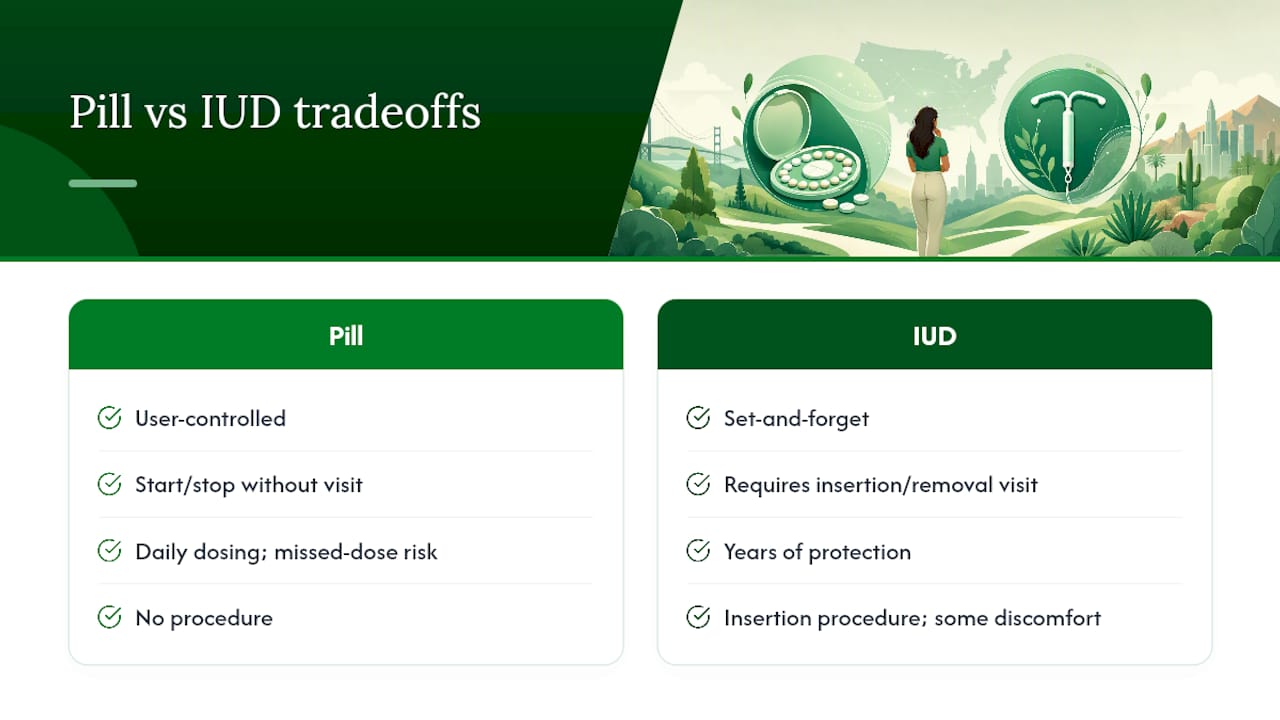
Effectiveness numbers only tell part of the story. The pill gives you control: you can start it, pause it, or stop it without an appointment, and it can double as treatment for acne or irregular cycles. Its downside is the daily commitment and the fact that a single missed dose creates real risk of pregnancy if timing slips.
IUDs remove that daily burden almost entirely, which is exactly why clinicians describe them as “set-and-forget.” You get years of protection from one procedure. The tradeoffs are upfront: insertion involves a clinical visit and some discomfort, and adjusting the dose or stopping mid-cycle isn’t an option; you either keep it in or have it removed.
There’s also a privacy dimension people don’t discuss enough. A pill pack sitting in a bathroom cabinet is visible in a way an IUD isn’t, which matters for some people navigating relationships or living situations where discretion is a priority. On the flip side, some patients don’t like the idea of a foreign device staying inside the body for years, even when the medical evidence supports its safety.
Cost structure differs too. The pill involves smaller, recurring costs (a monthly prescription), while an IUD is a larger upfront cost that then amortizes to near zero for years. If your income is irregular, that difference alone might tip the decision.
Health Conditions That Affect Your Options
Certain medical conditions rule methods in or out before lifestyle preference even enters the conversation.
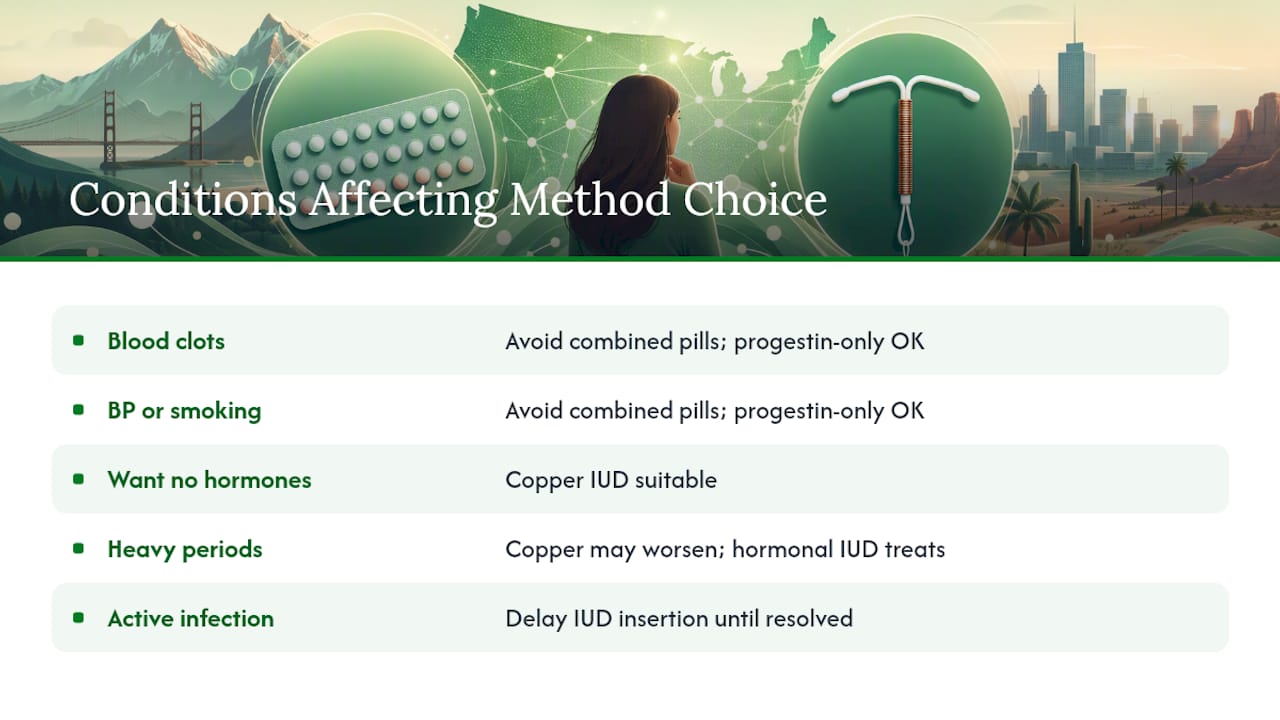
Combination pills are generally avoided in people with a history of blood clots, certain migraines with aura, uncontrolled high blood pressure, or active smoking after age 35, because the estrogen component raises clotting risk. Progestin-only pills sidestep most of that risk and are often the fallback for people who can’t take estrogen.
Copper IUDs work well for people who can’t or don’t want hormones, including those with a history of hormone-sensitive conditions, but they’re not ideal for people with very heavy or painful periods already, since copper can intensify both. Hormonal IUDs, meanwhile, are sometimes prescribed specifically to manage heavy menstrual bleeding, so they can flip from being a contraindication to a treatment depending on the person.
Anyone with an active pelvic infection, unexplained vaginal bleeding, or certain uterine abnormalities generally needs those issues resolved before IUD insertion. This is exactly the kind of nuance that makes a real conversation with a clinician, not a symptom checklist online, the safer starting point.
Non-Contraceptive Benefits Worth Knowing
Both methods do more than prevent pregnancy, and that’s often overlooked in a straight pill vs IUD comparison.
Combination pills can regulate irregular cycles, reduce acne, ease painful periods, and lower the long-term risk of ovarian and endometrial cancers with extended use. Hormonal IUDs offer a more targeted benefit: they can significantly reduce heavy menstrual bleeding, which is why some clinicians prescribe them as a treatment rather than purely as birth control, according to MedlinePlus.
Copper IUDs don’t carry hormonal side benefits, but they do serve as an option for people managing hormone-sensitive conditions who still want highly effective, reversible birth control. For some patients, that non-hormonal profile is the entire reason they choose it over anything else on the market.
Weight, Mood, and Libido: Separating Fact From Rumor
This is the question that comes up in nearly every consult, and the honest answer is: it varies by person, and the research doesn’t point to one method as clearly worse.
Weight change on both the pill and hormonal IUDs is generally modest for most users; large, consistent weight gain tied directly to either method isn’t well supported by strong evidence, though individual experiences differ. Copper IUDs, having no hormones, don’t carry this concern at all.
Mood changes are reported by some pill and hormonal IUD users, and both can occasionally trigger low mood or irritability in people already prone to it. If a method noticeably worsens your mood in the first few months, that’s a legitimate reason to switch, not something to push through.
Libido effects are the least predictable of the three. Some pill users report a dip, tied to how the hormones affect testosterone-binding proteins. Others notice no difference. IUDs, especially the copper version, tend to have less impact here simply because the hormonal load, if any, stays localized rather than systemic.
Breastfeeding and the Postpartum Period
Timing and hormone type both matter here more than usual.
Progestin-only pills and hormonal IUDs are generally considered compatible with breastfeeding, since progestin doesn’t meaningfully affect milk supply. Combination pills containing estrogen are typically avoided in the first weeks postpartum and while breastfeeding is being established, because estrogen can reduce milk supply in some people.
IUDs can often be placed within a few minutes after delivery of the placenta or at a postpartum visit around six weeks, depending on your provider’s protocol and your personal recovery. Pills can typically start sooner, though the exact timeline depends on breastfeeding status and any postpartum complications. This is a conversation to have directly with your OB or postpartum care provider, since individual recovery and delivery type change the recommended timing.
What Each Method Actually Costs
Cost is often the deciding factor once medical suitability is settled.
Pills usually mean a small recurring cost, either a monthly out-of-pocket charge or a copay, depending on insurance. Many U.S. insurance plans cover birth control pills at no cost when prescribed and filled in-network, a benefit worth confirming before you assume a price. Zealthy’s guide to birth control insurance coverage breaks down how to check and enforce that $0 coverage if your plan or pharmacy tries to charge you anyway.
IUDs carry a higher upfront cost for the device and insertion procedure, but that one payment then covers years of protection with no recurring charge. Many insurance plans cover IUDs fully as preventive care, though coverage details and provider network requirements vary. Availability differs by location too: pills can often be prescribed the same day through telehealth, while IUD insertion requires scheduling an in-person appointment with a clinician equipped to place one.
A Clinical Perspective on Matching Method to Life
A busy parent juggling school pickups rarely wants to remember a pill at 8 a.m. sharp; an IUD tends to fit better there. A student on a tight budget who wants flexibility to stop before a planned pregnancy often prefers the pill. Whichever you choose, plan a follow-up visit to reassess fit, and keep using condoms if STI protection is part of your picture.
— Bryan
Get Contraceptive Care Without the Waiting Room
Once you’ve weighed the pill vs IUD tradeoffs, the next step is getting an actual prescription, not another article. Zealthy gets you there faster than a traditional clinic by pairing same-day virtual appointments with prescription delivery, so a birth control conversation that used to take weeks to schedule can happen this week instead.

Booking works like this: you fill out a short health history, get matched with a licensed provider for a virtual visit, and walk away with a personalized plan, whether that’s a pill prescription sent to your pharmacy or guidance on next steps for an IUD referral. Zealthy’s birth control page walks through the specific options available and what a visit involves. If you’re also managing something like acne, irregular cycles, or need a broader checkup, Zealthy’s primary care service can fold that into the same visit instead of juggling separate appointments. Book a consult today and get a plan that actually matches your life, not just your symptoms.
Sources
- Intrauterine devices (IUDs) — WHO
- Deciding about an IUD: MedlinePlus Medical Encyclopedia
- IUD vs. the Pill: Which Birth Control Is Right for You? — Cleveland Clinic
Always confirm personal fit with a licensed clinician before starting or switching methods.
This article is general information, not a substitute for advice from a qualified doctor. Consult a qualified healthcare professional about your own circumstances before acting on anything here.
FAQ
Is an IUD Healthier Than the Pill?
Neither is inherently “healthier,” since each carries a different risk and benefit profile depending on your health history. Hormonal IUDs can reduce heavy bleeding with a low, localized hormone dose, while copper IUDs avoid hormones entirely; the pill offers benefits like acne control but carries clotting risks for some people, per MedlinePlus.
Why Are Some People Against IUDs?
Common concerns include fear of insertion pain, discomfort with a device remaining inside the body for years, and irregular bleeding in the first few months of use. Most of these concerns ease with time and proper counseling, and Cleveland Clinic notes that severe, persistent pain is the actual warning sign to watch for, not temporary adjustment symptoms.
What Is the Healthiest Form of Birth Control?
There isn’t one universally “healthiest” method; the best choice depends on your medical history, bleeding patterns, and lifestyle. Copper IUDs suit people avoiding hormones entirely, hormonal IUDs suit those wanting lighter periods with minimal maintenance, and pills suit people who want flexible, self-managed control. A telehealth visit through Zealthy can help match your specific health profile to the right option.
Do You Gain More Weight on the Pill or IUD?
Evidence doesn’t clearly show one method causing more weight gain than the other for most users. Copper IUDs carry no hormonal component, so they’re not linked to hormone-driven weight change, while both the pill and hormonal IUDs show inconsistent, generally modest effects on weight across individuals.


.svg)
.svg)
.svg)
.svg)

