Propranolol reliably calms the physical symptoms of anxiety, the racing heart, the shaking hands, the sweating, but it does not touch the underlying worry or thought patterns driving them. It works best as a short-term tool for situational or performance anxiety, taken before a specific stressor like public speaking or an audition. It is not a routine first-line treatment for generalized anxiety disorder, and anyone considering it needs a clinician to screen for asthma, certain heart conditions, and other contraindications first.
TL;DR:
- Propranolol is effective for reducing physical symptoms of situational anxiety but does not address underlying worry or thought patterns.
- It works best when taken 30 to 60 minutes before a predictable event, with effects lasting several hours due to its half-life of about four hours.
- Suitable candidates are those with clear, short-term triggers like public speaking, performances, or exams, rather than chronic or generalized anxiety disorders.
- Contraindications include asthma, certain heart conditions, and interactions with other heart rate medications, requiring responsible screening before use.
- Overdose can be severe, so proper dosing, gradual withdrawal, and close medical follow-up are essential for safe treatment.
Table of Contents
- How Does Propranolol Work for Anxiety?
- Does Propranolol Actually Help With Anxiety?
- Who Actually Benefits From Propranolol for Anxiety?
- How Should Propranolol Be Dosed for Anxiety?
- What Are the Side Effects and Risks of Propranolol?
- What Happens if You Take Too Much Propranolol?
- Should Propranolol Be Combined With Therapy or Other Treatments?
- A Clinical Look at Assessing Propranolol Requests
- How Do You Safely Stop Taking Propranolol?
- Is Propranolol Safe During Pregnancy or Breastfeeding?
- Can Propranolol Affect Memory or Concentration?
- Who Should Be Screened Before Starting Propranolol for Anxiety?
- A Clinical Perspective on Cautious, Targeted Use
- Get Evaluated for Anxiety Treatment Through Zealthy
- Sources
- FAQ
How Does Propranolol Work for Anxiety?
Propranolol belongs to a class of drugs called beta-blockers, and it works on the body, not the brain’s emotional circuitry. When you feel anxious, your adrenal glands release epinephrine (adrenaline), which binds to beta-adrenergic receptors and triggers the classic fight-or-flight response: a pounding heart, trembling hands, sweaty palms, sometimes a wave of nausea. Propranolol is a nonselective beta-adrenergic antagonist, meaning it blocks those receptors broadly rather than targeting just one subtype, which dampens the physical cascade even while the anxious thought itself stays fully intact.
That distinction explains a lot about why people describe propranolol so differently from other anxiety medications. It doesn’t create a sense of calm or detachment the way a benzodiazepine might. It simply keeps your body from broadcasting the anxiety to everyone in the room.
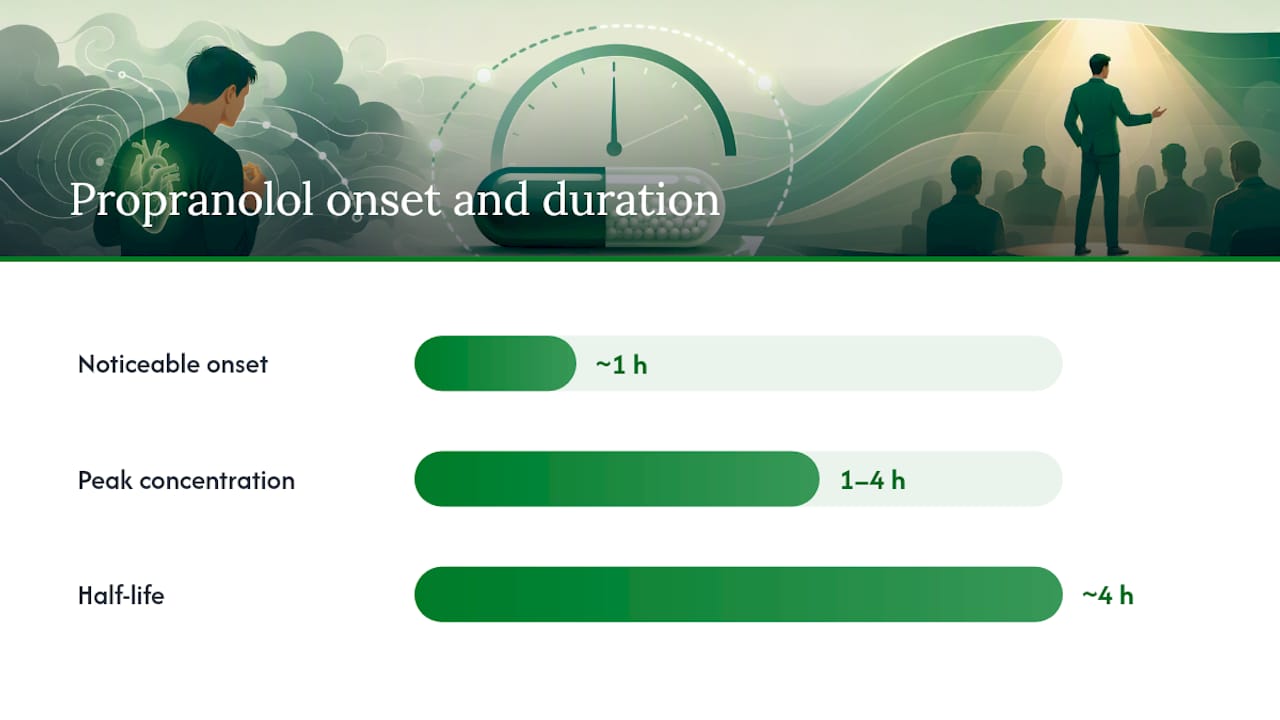
Timing matters more with propranolol than with most psychiatric medications. According to StatPearls, oral propranolol typically starts producing noticeable symptom relief within about an hour, with peak plasma concentrations reached somewhere between one and four hours after ingestion. The drug’s half-life runs around four hours, so a single dose tends to clear the body relatively quickly compared to medications meant for sustained daily control.
One pharmacokinetic detail catches a lot of people off guard: propranolol is highly lipophilic, meaning it dissolves easily in fat and crosses the blood-brain barrier with relative ease. That’s part of why some patients notice central effects, like vivid dreams or mild fatigue, on top of the peripheral symptom relief. It also means food can shift how much of the drug your body actually absorbs.
A few practical mechanics worth knowing before your first dose:
- Propranolol blocks peripheral adrenergic symptoms like heart rate, tremor, and sweating rather than addressing the psychological trigger itself.
- Its lipophilic structure lets it cross into the central nervous system, which explains occasional cognitive or mood-related side effects.
- Onset is usually felt within an hour, with peak effect between one and four hours and a half-life near four hours.
- Meals, especially protein-rich ones, can increase how much propranolol your body absorbs, so consistent timing around food matters if you’re dosing for a predictable event.
Does Propranolol Actually Help With Anxiety?
The evidence splits sharply depending on which kind of anxiety you’re talking about, and that split matters more than almost anything else in this article.
For generalized anxiety disorder, panic disorder, and social anxiety disorder as chronic, ongoing conditions, the research is thin and inconsistent. A systematic review and meta-analysis published in the Journal of Psychopharmacology found insufficient evidence to support propranolol as a routine treatment for these disorders. Trials comparing it against placebo or against benzodiazepines showed mixed results, and propranolol did not demonstrate consistent superiority for the broader anxiety disorders as a category.
For situational and performance anxiety, the picture looks noticeably better. The same body of research points to more reliable benefit when the goal is reducing physiologic symptoms, tremor, racing pulse, sweating, during a discrete, predictable stressor. Small trials and case reports involving musicians and surgeons have documented measurable reductions in hand tremor and physical anxiety symptoms after a single dose, which is part of why performance-anxiety protocols developed specifically around this use case.
The gap between “helps performance anxiety” and “treats anxiety disorders” is the single most misunderstood fact about this drug. Propranolol was never designed as an anxiolytic in the way SSRIs or benzodiazepines are. It was developed as a cardiovascular medication, and its anxiety application grew out of the observation that blocking adrenergic symptoms also blunts the physical loop that feeds anxious feelings. That mechanism works well when the anxiety is tied to a specific, short-lived event. It works far less predictably when the anxiety is generalized, persistent, or rooted in something other than an adrenaline surge.
A few methodological caveats are worth sitting with before drawing firm conclusions from any of this:
- Many of the supporting trials are small, decades old, and heterogeneous in dosing, population, and outcome measures.
- Performance-anxiety studies often rely on self-reported symptom scales rather than long-term functional outcomes.
- Comparison trials against benzodiazepines and SSRIs vary widely in design, making head-to-head conclusions shaky.
- Few large, modern randomized controlled trials exist specifically isolating propranolol’s effect on anxiety symptoms apart from its cardiovascular action.
The clinical takeaway most prescribers land on: propranolol is a reasonable off-label option for situational symptom control, especially when the physical symptoms themselves are the impairing part of the experience, a musician whose hands shake too badly to play, a public speaker whose voice cracks under a racing heart. It is not positioned, in guidelines or in the evidence base, as a routine or first-line therapy for generalized anxiety disorder. That role still belongs to SSRIs, SNRIs, and structured psychotherapy.
Who Actually Benefits From Propranolol for Anxiety?
Situational anxiety, sometimes called performance anxiety, is anxiety triggered by a specific, identifiable event rather than a persistent, free-floating worry. The trigger has a start and an end. The physical symptoms show up predictably beforehand and fade once the event is over. That pattern is exactly what propranolol is built to interrupt.
If your anxiety fits that shape, here are the scenarios clinicians see most often:
- Public speaking and presentations. The classic case: a racing heart and shaking hands right before stepping up to a podium, made worse by the fact that an audience can see the tremor and hear the shakiness in your voice.
- Musical and stage performance. Musicians, especially string and wind players, sometimes describe a hand tremor severe enough to affect technique, which is part of why performance-anxiety medical protocols specifically address propranolol dosing for concert situations.
- Exams and high-stakes tests. Test anxiety that manifests as a pounding heart, sweaty palms, or a shaky hand while writing can respond to the same short-term approach, though this use is more variable and less studied than performance settings.
- High-stakes professional performance under stress. Surgeons, pilots, and other professionals working under acute physical scrutiny have reported reduced tremor and steadier hands with pre-task dosing, according to case-based evidence cited in the performance anxiety literature.
- Brief, predictable social situations. A wedding toast, a job interview, a first date, any one-off event where the fear is less about the situation itself and more about visibly shaking or sweating in front of others.
What ties these scenarios together is predictability. You know roughly when the stressor starts and ends, which makes as-needed dosing straightforward. That’s different from generalized anxiety, where the trigger is diffuse and dosing propranolol on a fixed schedule doesn’t map cleanly onto anything.
How Should Propranolol Be Dosed for Anxiety?
Dosing for situational anxiety looks nothing like dosing for a heart condition, and that distinction trips up a lot of people who read the drug’s cardiology-focused label and assume the numbers apply the same way.
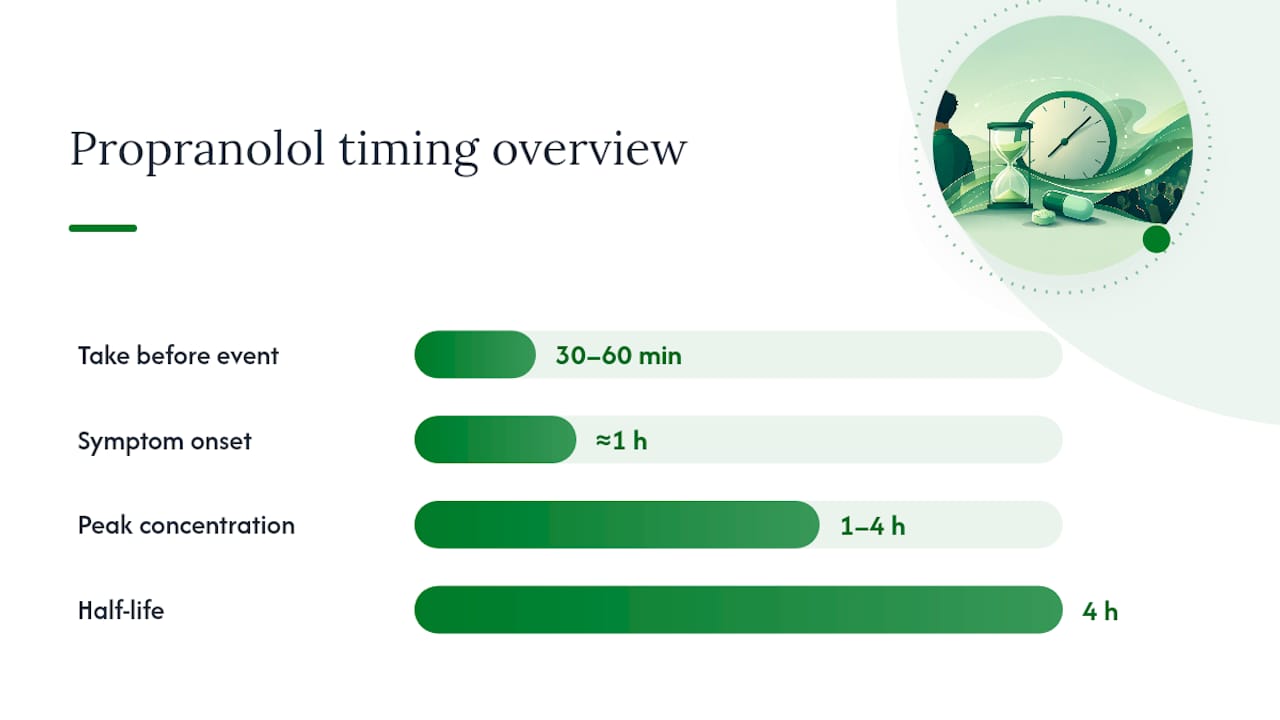
For an as-needed approach to performance or situational anxiety, clinicians commonly prescribe a low-to-moderate dose, typically taken roughly 30 to 60 minutes before the anxiety-provoking event. That window lines up with the drug’s absorption curve: onset within about an hour, peak plasma concentration between one and four hours, according to MedlinePlus. The goal is to have the medication actively blunting adrenergic symptoms right as the stressful event begins, not hours before or after.
Dosages in the research literature vary more than that range might suggest. Some performance-anxiety trials used doses as low as 10 milligrams; others tested higher doses depending on body weight and the intensity of the anticipated stressor. There is no single “correct” dose. It’s a starting point a clinician adjusts based on how you respond, sometimes after a low-stakes trial run before the dose is used for something that actually matters.
Extended-release formulations of propranolol exist and are prescribed for cardiovascular conditions on a daily schedule, but they are not the standard approach for situational anxiety. Daily dosing regimens for anxiety do exist in some clinical contexts, generally when someone has frequent, recurring situational triggers rather than one-off events, but that’s a decision made with a prescriber who can weigh the cumulative side-effect profile against the benefit.
A few practical points worth keeping straight:
- As-needed doses for situational anxiety commonly fall between 10 and 40 milligrams, taken 30 to 60 minutes before the triggering event.
- Extended-release formulations are built for cardiovascular dosing schedules, not typical situational anxiety use.
- Effects generally last several hours, which usually covers the length of a speech, performance, or exam, but the half-life of about four hours means the effect does fade.
- Propranolol should be used only under a clinician’s direction, and never combined with other blood pressure or heart rate medications without that clinician’s explicit review.
Pro Tip: If you’re planning to use propranolol before a specific event for the first time, do a low-stakes trial run days beforehand, at home, on a normal evening, so you know how your body responds before you rely on it for something that matters.
The margin for error with propranolol is narrower than people assume, mostly because the “right” dose depends on your resting heart rate, blood pressure, and any other medications you’re taking. That’s not a reason to avoid it. It’s a reason to get the dose set by someone who can look at your full medical picture rather than guessing from a forum post.
What Are the Side Effects and Risks of Propranolol?
Propranolol’s side effect profile splits cleanly into “common and manageable” and “serious and requires screening first,” and conflating the two is where most confusion happens.
The common side effects show up in a meaningful minority of people and are rarely dangerous: fatigue, dizziness, cold hands or feet, vivid or unusual dreams, and sexual dysfunction. Most of these are dose-related and tend to ease as your body adjusts, or they resolve entirely once the medication clears, which happens relatively fast given the roughly four-hour half-life.
The serious risks are the reason propranolol requires a real medical screening before you start it, not a quick online form. According to the drug’s FDA-approved label, the more serious adverse events include bradycardia (an abnormally slow heart rate), hypotension, bronchospasm, and conduction abnormalities affecting the heart’s electrical rhythm. Because the drug crosses into the central nervous system, some patients also experience mood changes or depressive symptoms with longer-term use, which matters if you already have a mood disorder alongside your anxiety.
| Category | What to know |
|---|---|
| Common side effects | Fatigue, dizziness, cold extremities, vivid dreams, sexual dysfunction |
| Serious cardiovascular risks | Bradycardia, hypotension, conduction abnormalities |
| Respiratory risk | Bronchospasm, especially dangerous in people with asthma or COPD |
| CNS-related risk | Mood changes or depressive symptoms with longer-term use, tied to the drug’s ability to cross the blood-brain barrier |
| Contraindications | Active asthma or COPD with bronchospasm, certain heart blocks, decompensated heart failure |
| Key interactions to flag | Other antihypertensives or heart rate medications, and drugs that share major metabolic pathways with propranolol |
Contraindications are non-negotiable, not preferences. Active asthma or COPD with a bronchospasm component is a hard stop for most prescribers, because propranolol’s nonselective beta-blockade can worsen airway constriction. Certain types of heart block and decompensated heart failure are similarly disqualifying without specialist cardiology input. This is exactly why a legitimate telehealth evaluation includes a real medical history and, when appropriate, vitals review, rather than a simple symptom checklist.
Drug interactions deserve their own careful look before you start. Combining propranolol with other blood pressure or heart rate medications can compound the bradycardia and hypotension risk beyond what either drug would cause alone. Certain medications share metabolic pathways with propranolol, which can raise blood levels of one or both drugs unpredictably. The safest approach is straightforward: bring your full medication list, including over-the-counter drugs and supplements, to whoever is prescribing this, and let them check for conflicts before you fill the prescription.
What Happens if You Take Too Much Propranolol?
Overdose with propranolol is a genuine medical emergency, not a “call it in the morning” situation, and the reason comes back to that same lipophilic property that makes it effective for anxiety in the first place.
Because propranolol crosses into the central nervous system so readily, overdose can produce a combination of severe bradycardia, dangerously low blood pressure, arrhythmia, and in serious cases, seizures or loss of consciousness. A British Journal of General Practice review specifically flags that propranolol’s toxicity in overdose is more severe than many other anxiety medications, which is a notable asymmetry given how limited the evidence is for its routine efficacy in generalized anxiety. In plain terms: the risk-benefit math looks worse than people assume when propranolol is prescribed loosely rather than for a targeted, situational purpose.
Anyone showing signs of overdose, an extremely slow or irregular heartbeat, fainting, confusion, or seizures, needs emergency medical attention immediately. This isn’t a symptom set to manage at home.
That toxicity risk is exactly why responsible prescribers build precautions into how they hand out this medication in the first place:
- Limiting the quantity dispensed at any one time, especially for new patients, rather than writing a large supply upfront.
- Scheduling routine follow-up rather than a one-time prescription with no check-in.
- Screening for suicidality before initiating treatment, particularly in younger patients, given documented fatalities in overdose cases.
- Reviewing every other medication a patient takes for compounding cardiovascular effects before adding propranolol to the mix.
These aren’t bureaucratic hoops. They reflect a real asymmetry in the risk profile: a drug with modest, situational benefit and a genuinely dangerous overdose potential deserves tighter prescribing guardrails than a drug with a wider safety margin, even when both are technically “just for anxiety.”
Should Propranolol Be Combined With Therapy or Other Treatments?
Propranolol treats what your body does when you’re anxious. It does nothing for what your mind is telling you about the situation, and that gap is exactly where therapy and other medications earn their place.
Cognitive behavioral therapy addresses the thought patterns and avoidance behaviors that keep anxiety running long after any single event has passed. For someone with true situational anxiety, pairing an as-needed propranolol dose with therapy techniques, like rehearsal, exposure, or cognitive reframing, tends to produce more durable improvement than medication alone, because the therapy chips away at the underlying fear response rather than just muting its physical signature.
For anxiety that’s chronic rather than situational, generalized anxiety disorder, panic disorder, ongoing social anxiety, the first-line treatments look different entirely. SSRIs and SNRIs, medications like escitalopram or citalopram, are the guideline-preferred pharmacologic starting point, usually alongside CBT. Bupropion is sometimes considered as an alternative when SSRIs aren’t a good fit. Short-term benzodiazepines occasionally come into play for acute, severe symptoms, but their dependence potential means most clinicians reserve them for brief, closely monitored use rather than ongoing management.
How does a clinician actually choose between these paths? A few decision points tend to drive it:
- If the anxiety is tied to a specific, recurring, predictable event and the main impairment is physical (shaking, racing heart), a trial of as-needed propranolol is often reasonable.
- If anxiety is present most days, regardless of specific triggers, an SSRI or SNRI paired with therapy is the more evidence-backed starting point.
- If symptoms are severe and acute, with functional impairment right now, short-term benzodiazepine use might bridge the gap while a longer-term plan, like an SSRI, takes weeks to build up effect.
- If the anxiety is largely thought-driven rather than physically driven, therapy alone may outperform any medication.
The honest answer for a lot of people is “some combination of these,” decided collaboratively with a prescriber who actually reviews your history rather than defaulting to whichever option is easiest to prescribe.
A Clinical Look at Assessing Propranolol Requests
Assessing whether propranolol makes sense for someone starts with a real medical history, not a symptom checklist. A thorough evaluation covers cardiac and respiratory history specifically, because the two biggest contraindication categories, bronchospastic lung disease and certain heart rhythm disorders, are exactly the conditions that make this drug risky rather than helpful.
A responsible workup typically walks through several checkpoints: a review of current vitals, particularly resting heart rate and blood pressure, since propranolol will push both lower; a screen for asthma or COPD history, since even well-controlled asthma warrants caution; a full medication list to catch interactions with other heart rate or blood pressure drugs; and a brief mental health screen, including a check for suicidality, given the toxicity concerns in overdose.
This is where an integrated telehealth model earns its keep. Zealthy’s mental health care is built around same-day evaluations that pull in both mental health and primary care history in one visit, rather than treating anxiety in isolation from the cardiovascular screening that actually determines whether propranolol is safe for a given patient. That matters practically: a patient with well-controlled anxiety but undiagnosed mild asthma is exactly the kind of case that a fragmented, mental-health-only intake can miss.
Follow-up matters just as much as the initial screen. Prescribing propranolol responsibly means checking back in, not writing one prescription and disappearing. That’s part of why platforms combining same-day access with prescription delivery and structured follow-up exist: the goal isn’t just getting a prescription filled quickly, it’s making sure someone is actually watching how you respond to it over time.
How Do You Safely Stop Taking Propranolol?
Stopping propranolol abruptly after regular or extended use, rather than the occasional as-needed dose before an event, carries a real risk that a lot of anxiety-focused guidance skips over entirely: rebound symptoms.
Beta-blockers, propranolol included, can cause a rebound effect when stopped suddenly after consistent use. Your body has adjusted to blunted adrenergic signaling, and pulling that away all at once can trigger a temporary surge in heart rate, blood pressure, and anxiety-adjacent physical symptoms, sometimes worse than what you started with. This is a well-documented phenomenon with beta-blockers used for cardiovascular conditions, and the same physiological principle applies when they’ve been used regularly for anxiety.
For someone using propranolol purely as-needed, a dose here or there before specific events, this isn’t much of a concern, since the drug never builds up a sustained presence for your body to adjust around. The risk becomes real when propranolol has been taken daily or near-daily for weeks or longer.
If you’ve been on a regular schedule and want to stop, the safest approach is a gradual taper under a clinician’s guidance rather than quitting outright. There’s no universal taper schedule that fits everyone; it depends on your dose, how long you’ve been taking it, and your cardiovascular baseline. What matters is not doing it alone. Loop in whoever prescribed it, describe why you want to stop, and let them build a step-down plan that avoids handing you a rebound anxiety spike on top of whatever you were trying to manage in the first place.
Is Propranolol Safe During Pregnancy or Breastfeeding?
Pregnancy and breastfeeding change the risk calculation for any medication, and propranolol is no exception, though it isn’t automatically off the table the way some anxiety medications are.
Propranolol has a longer history of use in pregnancy than many psychiatric medications, largely because it’s also prescribed for cardiovascular conditions and hypertension that can occur during pregnancy. That history gives clinicians more data to work with, but it doesn’t make the decision automatic. Beta-blockers have been associated with effects on fetal growth in some contexts, and the decision to use propranolol during pregnancy needs to weigh the specific anxiety symptoms against alternative approaches, including therapy-first strategies that carry no medication risk at all.
Breastfeeding adds a separate layer of consideration. Propranolol does pass into breast milk, generally in small amounts, and standard guidance is that this needs individualized review with your prescriber and, often, your infant’s pediatrician, rather than a blanket yes or no.
If you’re pregnant, trying to conceive, or breastfeeding and dealing with situational or performance anxiety, the honest starting point is a conversation with a clinician who knows your full picture, not a generic answer pulled from a label. Non-medication strategies, like structured breathing techniques, exposure-based rehearsal, or therapy, often become the first line during these windows precisely because they carry zero pharmacological risk to consider. When medication is genuinely warranted, the decision belongs to you and a provider reviewing your specific circumstances together.
Can Propranolol Affect Memory or Concentration?
Propranolol’s reputation is built almost entirely around physical symptom relief, but its ability to cross into the central nervous system means it isn’t purely a “body only” drug, and that has real implications for anyone whose job or daily function depends on sharp focus.
Because propranolol is lipophilic and penetrates the blood-brain barrier readily, it can produce mild central effects beyond the intended symptom relief: fatigue, occasional lightheadedness, and for some people, a subjective sense of mental fog or slowed processing, particularly at higher doses. This isn’t universal, and most people using it for occasional performance anxiety report the primary sensation as a physical calming rather than any noticeable dulling of thought.
That said, this is worth flagging clearly for anyone planning to use propranolol before a task that itself demands sharp mental performance, an exam that requires quick recall, a presentation with complex material to track, a procedure requiring fine motor precision under time pressure. The drug’s job is to quiet the tremor and racing heart that interfere with performance, not to sharpen cognition, and in a small subset of people the CNS-level side effects can work against the very outcome you’re trying to protect.
The practical fix is the same one mentioned earlier: test it before you need it. A low-stakes trial run at home lets you calibrate whether your particular response includes any cognitive fog, well before you’re relying on the medication for something with real stakes attached, an exam, a performance, a presentation you can’t redo.
Who Should Be Screened Before Starting Propranolol for Anxiety?
Patient selection is where a lot of the real safety work happens, and it’s the part that gets skipped when propranolol is treated as a low-risk, casual option rather than a prescription medication with genuine contraindications.
A responsible screening process before starting propranolol for anxiety looks at several specific categories. Respiratory history comes first: active asthma or COPD with any bronchospastic component is a serious flag, since propranolol’s nonselective beta-blockade can trigger airway constriction. Cardiac history follows closely behind, particularly any history of heart block, bradycardia, or decompensated heart failure, all of which the drug’s label lists as contraindications or major cautions.
Beyond the obvious physical screens, a full medication review matters just as much. Anyone already taking other blood pressure or heart rate medications needs that interaction assessed before propranolol enters the picture, since the combined effect on heart rate and blood pressure can compound quickly. A mental health screen, including a direct check for suicidal ideation, belongs in the intake too, given the documented toxicity risk in overdose and the value of catching risk factors before, not after, a prescription is written.
Good patient selection isn’t about gatekeeping access. It’s about making sure the person on the other end of that prescription is actually a good candidate for a drug that works well in the right context and poses real risk in the wrong one. That’s the entire argument for treating this as a genuine medical decision rather than a quick online questionnaire.
A Clinical Perspective on Cautious, Targeted Use
If I were weighing whether to prescribe propranolol for anxiety, the deciding factor would almost never be how anxious someone feels in the abstract. It would be whether the anxiety has a shape, a specific trigger, a predictable window, a physical symptom that’s genuinely getting in the way. That’s the population where the evidence holds up and the risk-benefit math works in the patient’s favor. Outside that population, I’d be far more cautious, because the data on propranolol for generalized or chronic anxiety just isn’t strong enough to justify it as a default choice over an SSRI or structured therapy.
Monitoring matters more than most people expect from a medication that seems this simple. A resting heart rate check, an honest conversation about asthma history, a real look at what else is in someone’s medicine cabinet, none of that is optional. And I’d never prescribe it as a standalone fix. The physical symptoms are only half the problem; the thoughts underneath them need their own plan, whether that’s therapy, an SSRI, or both.
— Bryan
Get Evaluated for Anxiety Treatment Through Zealthy
Figuring out whether propranolol, an SSRI, therapy, or some combination fits your specific anxiety pattern isn’t something you should have to sort out alone from a search results page. Zealthy gives you a same-day path to a real evaluation: a licensed provider reviews your medical history, screens for the contraindications that actually matter (cardiac and respiratory history, current medications, mental health risk factors), and builds a plan around what your anxiety actually looks like, situational or chronic, rather than handing out a prescription based on a symptom checklist.

If a prescription is appropriate, Zealthy handles delivery and sets up follow-up so someone is actually tracking how you respond, not leaving you to figure out dosing or side effects solo. And because Zealthy’s mental health care sits on the same platform as primary care, the provider evaluating your anxiety can also flag physical health issues, like undiagnosed asthma or a heart rhythm concern, that a mental-health-only intake might miss entirely. Booking an assessment takes a few minutes online, and you can start today at Getzealthy.
Sources
The clinical claims throughout this guide draw on a small set of authoritative sources rather than general web consensus. The StatPearls overview of propranolol grounds the mechanism, onset, and pharmacokinetics sections. The systematic review and meta-analysis in the Journal of Psychopharmacology supplies the efficacy evidence separating performance anxiety from chronic anxiety disorders. The drug’s FDA label on DailyMed anchors the side effect and contraindication details, while MedlinePlus informed the practical dosing and timing guidance. A pharmacokinetic study on food effects and a British Journal of General Practice review of overdose toxicity rounded out the absorption and safe-prescribing sections.
This article is general information, not a substitute for advice from a qualified doctor. Consult a qualified healthcare professional about your own circumstances before acting on anything here.
- Propranolol - StatPearls - NCBI Bookshelf
- Propranolol for the treatment of anxiety disorders: Systematic review and meta-analysis (J Psychopharmacol)
- Propranolol (Inderal) — DailyMed label
- Propranolol - MedlinePlus Drug Information
FAQ
What Happens When You Take Propranolol for Anxiety?
Propranolol blocks the physical effects of adrenaline, so your heart rate slows, trembling eases, and sweating decreases within roughly an hour of taking it. It doesn’t change your anxious thoughts or feelings directly; it just quiets the body’s alarm response tied to them, according to StatPearls.
Is Propranolol or Xanax Better for Anxiety?
Neither is universally “better”; they treat different things. Propranolol targets physical symptoms for situational anxiety with low dependence risk, while Xanax (alprazolam) works more broadly on anxious feelings but carries dependence and withdrawal risks that make it unsuitable for regular long-term use.
What Medication Is Used for Severe Anxiety?
Severe or chronic anxiety is typically treated first with SSRIs or SNRIs, such as escitalopram or citalopram, often paired with cognitive behavioral therapy. Short-term benzodiazepines are sometimes used for acute severe symptoms, while propranolol is reserved mainly for the physical symptoms of situational anxiety rather than severe generalized anxiety.
How Long Does Propranolol Take to Kick In for Anxiety?
Most people notice symptom relief within about an hour of taking propranolol, with peak effect between one and four hours after the dose, according to MedlinePlus. That’s why clinicians typically recommend taking it 30 to 60 minutes before a specific anxiety-provoking event.


.svg)
.svg)
.svg)
.svg)

